QuantLearn
Trading Strategies
Options Straddle
Volatility trading with options strategies
Straddle Backtest Results
Analysis of long straddle performance on STOXX 50 options with different strike prices. The strategy tests various entry points based on call-put price convergence.
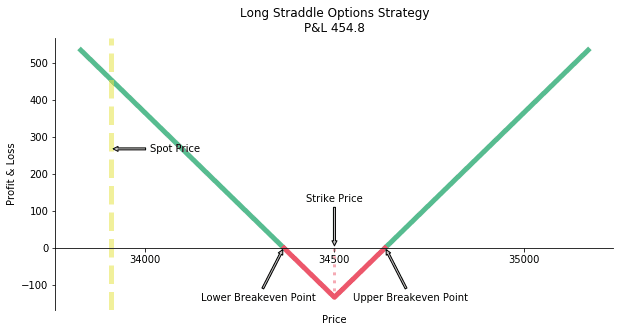
Options Straddle Payoff Diagram
Payoff diagram showing profit/loss zones. Green areas indicate profitable regions when spot price moves significantly away from strike price, while red areas show loss zones near the strike price where time decay dominates.
Options Straddle Theory
Options straddle is a volatility trading strategy that enables traders to profit from significant price movements regardless of direction. The strategy involves simultaneously buying a call option and a put option with the same strike price, same expiration date, and preferably similar option prices.
Long straddle has unlimited profit potential for upside movements and limited loss risk. The maximum loss occurs when the underlying asset closes exactly at the strike price at expiration, resulting in both options expiring worthless. The strategy is particularly effective for event-driven trading such as earnings announcements, political events, or major economic releases.
The core challenge lies in strike price selection and timing. Since option prices incorporate market consensus about future volatility, success depends on finding optimal strike prices that minimize the loss bandwidth. This is where fundamental analysis becomes crucial - economists provide base case outlooks plus best/worst scenarios to guide strike price selection.
Unlike common misconceptions about quantitative trading, Option Greeks are not a silver bullet. The most effective approach combines quantitative analysis with fundamental research (quantamental) to create robust trading strategies.
Mathematical Foundation
1Straddle Payoff Function
Where P(S_T) is the payoff at expiration, S_T is the spot price at expiration, K is the strike price, C is the call premium, and P is the put premium.
2Breakeven Points
The strategy becomes profitable when the underlying price moves beyond either breakeven point. The distance between breakevens represents the range where the strategy loses money.
3Maximum Loss
Maximum loss occurs when the underlying closes exactly at the strike price at expiration, making both options worthless. This represents the total premium paid.
4Signal Generation Threshold
Trading signal is generated when the absolute difference between call and put option prices is less than threshold θ, indicating price convergence and balanced market sentiment.
Algorithm Implementation
The options straddle algorithm focuses on identifying optimal entry points where call and put option prices converge, indicating balanced market sentiment and fair pricing.
Strike Price Filtering
def find_strike_price(df):
    temp = [re.search('\d{4}', i).group() for i in df.columns]
    target = []

    for i in set(temp):
        if temp.count(i) > 1:
            target.append(i)

    return target
Extracts strike prices that have both call and put options available. This is fundamental for straddle implementation as we need matching option pairs.
Data Preparation
def straddle(options, spot, contractsize, strikeprice):
    option = options[[i for i in options.columns if strikeprice in i]]
    df = pd.merge(spot, option, left_index=True, right_index=True)

    # Label columns appropriately
    temp = []
    for i in df.columns:
        if 'C' + strikeprice in i:
            temp.append('call')
        elif 'P' + strikeprice in i:
            temp.append('put')
        elif 'Index' in i:
            temp.append('spot')
        else:
            temp.append(i)

    df.columns = temp
    df['spot'] = df['spot'].apply(lambda x: x * contractsize)
    return df
Merges option price data with spot prices and normalizes column names. Contract size adjustment ensures proper profit/loss calculations for visualization.
Signal Generation
def signal_generation(df, threshold):
    df['signals'] = np.where(
        np.abs(df['call'] - df['put']) < threshold,
        1, 0
    )
    return df
Generates trading signals when call and put option prices converge within the specified threshold. This indicates balanced market sentiment and optimal entry conditions.
Profit Calculation
def calculate_profit(df, strikeprice, contractsize, entry_index):
    profit = np.abs(
        df['spot'].iloc[-1] - int(strikeprice) * contractsize
    ) - df['call'][entry_index] - df['put'][entry_index]

    return profit
Calculates the theoretical profit/loss based on final spot price relative to strike price, minus the total premium paid for both options.
Implementation Steps
- 1Identify available strike prices that offer both call and put options in the options chain
- 2Filter option pairs where call and put prices are converging (within threshold)
- 3Calculate contract size adjustments for proper position sizing and P&L calculations
- 4Generate trading signals when price convergence criteria are met
- 5Monitor position through expiration and calculate final profit/loss
- 6Plot payoff diagrams to visualize profit zones and breakeven points
- 7Implement risk management rules for early exit if volatility collapses
Key Metrics
Risk Considerations
Practice Implementation
Prerequisites
Mathematical Background
- • Linear regression and OLS estimation
- • Time series analysis (stationarity, unit roots)
- • Hypothesis testing and p-values
- • Basic econometrics (error correction models)
Technical Skills
- • Python programming (pandas, numpy)
- • Statistical libraries (statsmodels)
- • Data visualization (matplotlib)
- • Financial data handling (yfinance)
Complete Implementation
Access the full Python implementation from the original quantitative trading repository:
# Complete pair trading implementation
git clone https://github.com/je-suis-tm/quant-trading.git
cd quant-trading
python "Pair trading backtest.py"
# Modify tickers and parameters for your own analysis
Learning Checkpoints
Understand Cointegration
Can you explain why two assets might be cointegrated and what breaks this relationship?
Interpret Statistical Tests
Practice reading ADF test results and understanding when to accept/reject cointegration.
Signal Generation
Implement Z-score calculations and understand threshold selection (±1σ vs ±2σ).
Risk Management
Understand position sizing, monitoring regime changes, and exit strategies.
Recommended Learning Path
Immediate Actions
- Download and run the Python script
- Test with different asset pairs
- Experiment with threshold parameters
Advanced Studies
- Learn Johansen cointegration test
- Study Vector Error Correction Models
- Explore multiple asset pair trading
Important Disclaimer
This strategy involves significant risk. Historical cointegration relationships can break permanently. Always use proper risk management, position sizing, and never risk more than you can afford to lose. Paper trade extensively before using real capital.